
Know the estate
Inventory units, dependencies, behavior, data, interfaces, and uncertainty with source citations.
AIM is EvoFlux's migration control plane. It turns legacy source into approved knowledge, bounded target work, and deterministic evidence—through workflows people can inspect and govern.
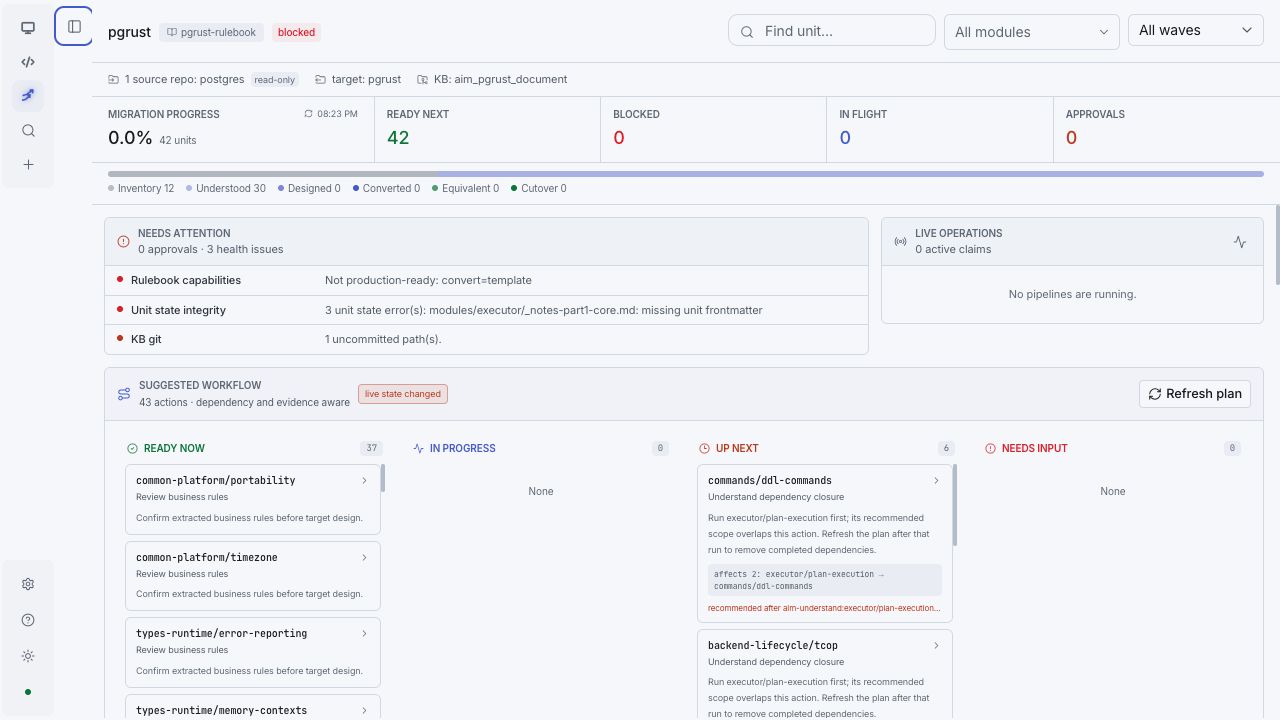
42 units · 9 waves · 945 knowledge files
AIM gives the program a shared answer to four questions: what exists, what is approved, what may run next, and what proves the result.
Inventory units, dependencies, behavior, data, interfaces, and uncertainty with source citations.
Version rules, mappings, readiness, responsibilities, and gates before work advances.
Write only to the approved target through explicit, inspectable workflows.
Link source, rules, mappings, builds, comparisons, verdicts, and approvals end to end.
Safety invariant: legacy source is observed, never rewritten. Implementation writes only to the approved target.
Each surface answers one operational question. Traceability connects the answers across the entire migration.
See estate progress, health, approvals, wave readiness, and the next safe work in one operating board.
State · queue · readiness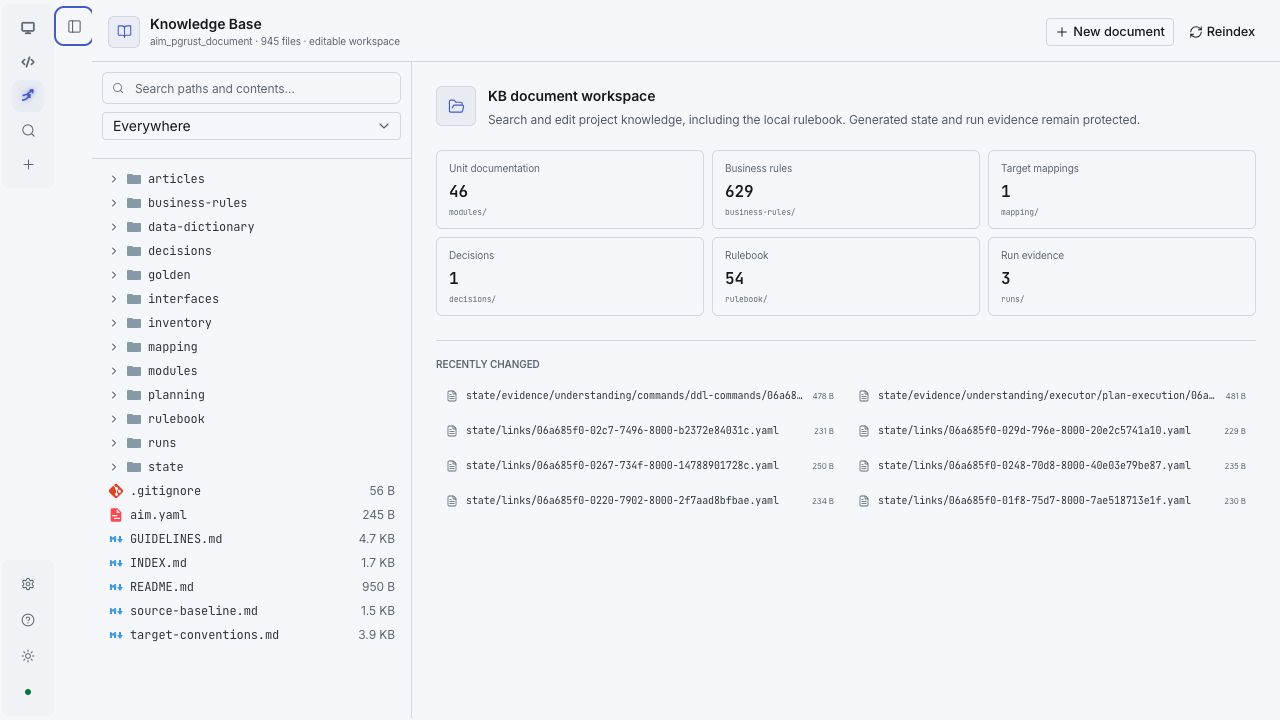
Keep units, rules, mappings, decisions, golden cases, and evidence as durable, reviewable project knowledge.
Shared truth · Git-trackable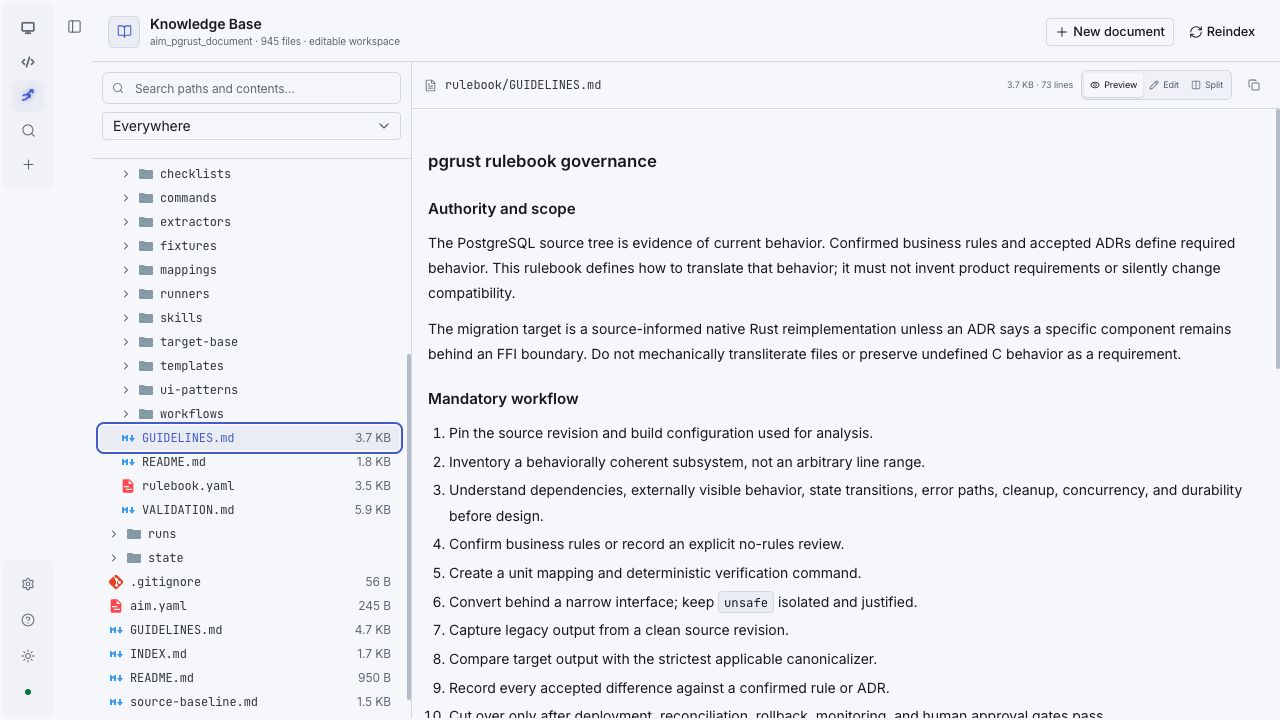
Define how this source stack becomes this target stack through versioned, project-specific operating policy.
Pinned identity · reviewed changes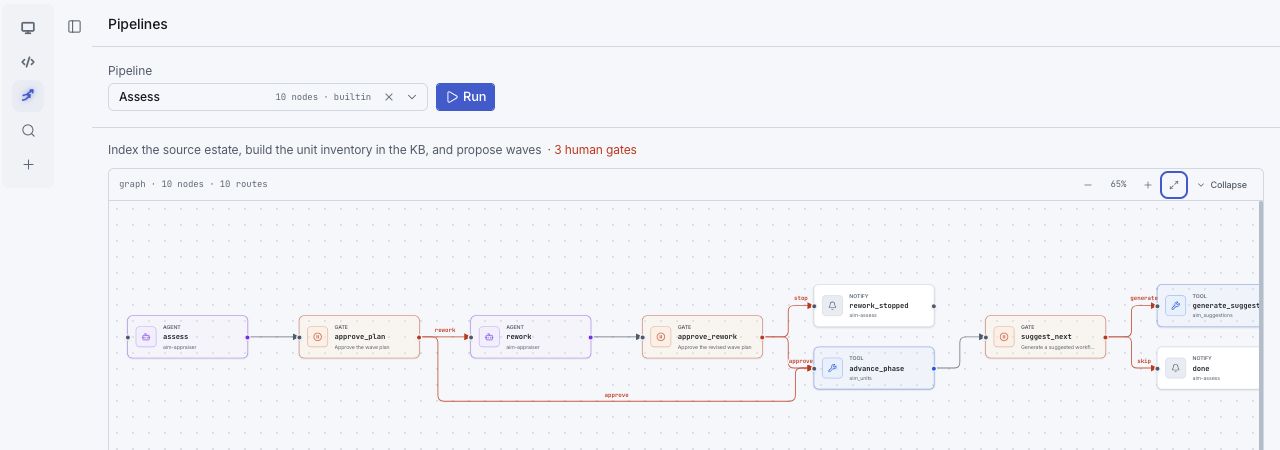
Run typed workflows with explicit tools, readiness checks, human gates, and linked outputs.
10 governed workflowsEach stage produces a reviewable artifact and unlocks the next only when its gate is satisfied.
Inventory the estate and plan dependency-aware waves.
Recover behavior, data, interfaces, and uncertainty with citations.
Confirm the business behavior that must survive.
Map approved behavior into the target architecture.
Build target code, tests, and reproducible evidence.
Prove observable behavior with deterministic comparison.
Recheck dependencies, approvals, and operational readiness.
A representative pilot exposes real dependencies and comparison noise while remaining small enough to finish and measure.
Map source, target, knowledge base, roles, and acceptance criteria.
Validate the Rulebook and required capabilities for the chosen stack pair.
Take representative units from assessment through deterministic comparison.
Expand with proven rules, patterns, evidence standards, and governance roles.
No. Conversion is one controlled stage. AIM first understands the estate, confirms rules, approves target design, then proves behavior before cutover.
No. Legacy source is mounted read-only. Writes go only to the target repository or the project knowledge base.
No. The Rulebook is adapted and validated during setup. Work stays blocked until the required capability is ready for the engagement.
The Git-tracked knowledge base holds unit state, rules, mappings, decisions, golden cases, and evidence. Local indexes can be rebuilt from it.
 AI Innovation Modernization
Bring one legacy estate, one approved target, and the evidence that matters.